Published
Both use the same thick safety glass and both give you a clear view of the water. The difference is what holds the glass at the base, and that changes the look, where each one can go and what it costs to build.
What frameless glass is
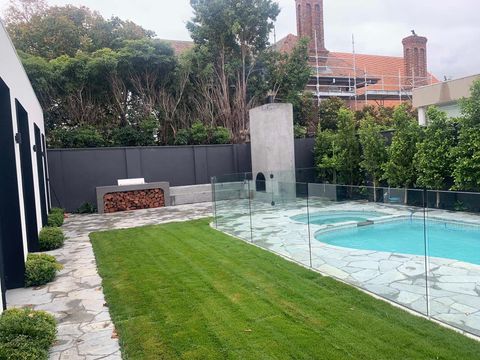
A frameless fence is a row of glass panels set into a hidden channel built into the ground. Nothing shows at the base: no spigots, no posts and no top rail, so the glass looks like it grows out of the paving.
- 12 mm toughened safety glass, tall enough that the top clears 1200 mm once it sits in the channel.
- A hidden channel built in with the paving.
- A glass gate on soft-close hinges with a glass-to-glass latch.
What semi-frameless glass is
Semi-frameless uses the same 12 mm glass, held on small stainless steel spigots at the base of each panel. There are still no posts or top rail, so you see straight through, but the spigots show at the bottom.
- Duplex 2205 stainless spigots, the grade made to stand up to chlorine and salt water.
- Three ways to fix it: core-drilled into concrete, base-plated onto a slab or deck, or side-mounted onto a wall.
- Finishes in polished, satin, matt black or matt white.
Side by side
| Frameless | Semi-frameless | |
|---|---|---|
| The look | Glass straight out of the ground, the cleanest finish | Glass on small spigots at the base |
| Glass | 12 mm toughened | 12 mm toughened |
| Best for | New paving, new pools and landscaping jobs | Existing slabs and decks, raised pools and long runs |
| Cost per metre | Higher | Lower |
| Install | The channel goes in with the paving | Fixes to the surface that is already there |
Where frameless makes sense
Choose frameless where you look at the fence the most and the paving is new or being redone: the side of the pool facing the house, the alfresco area or anywhere you want the view across the water to feel completely open.
Where semi-frameless makes sense
Semi-frameless is the answer when the paving is staying: spigots fix to an existing slab or deck, or to the face of a retaining wall on a raised pool. It also earns its place on the long runs you mostly see side-on, where the lower cost per metre adds up quickly.
The mix most people end up with
Plenty of Melbourne pools use both: frameless across the entertaining side, and semi-frameless, steel rod or aluminium down the side where nobody sits. You get the premium look where it counts and save on the rest.
Both have to pass the same rules
Whichever you choose, the barrier must be at least 1200 mm high from finished ground level, have gaps of 100 mm or less, keep a 900 mm non-climbable zone on the outside, and have a gate that swings away from the pool and closes and latches by itself. Read the Victorian compliance guide for the details.
Not sure which suits your pool? We look at the site, the ground and how you use the yard, and quote frameless, semi-frameless or a mix so you can compare.